

Olia Fedorova – Residency Cité internationale des arts
Residency / Cité internationale des arts / Paris
***For English version please scroll down
Für den Zeitraum von zwei Monaten im Frühjahr 2025 (Februar bis Mai) wurde im Rahmen einer Kooperation mit der Cité internationale des arts in Paris, dem Österreichischen Kulturforum Paris und dem Institut Français d’Autriche eine Residency in der Cité internationale des arts in Paris an Olia Fedorova vergeben.
Die multidisziplinäre Künstlerin wurde 1994 in Charkiw in der Ukraine geboren und bewegt sich in ihrer Arbeit zwischen Konzeptkunst, Text und Textilien, Fotografie und Video. Seit Ende 2022 lebt und arbeitet sie zwischen Graz und Linz in Österreich. 2024 begann sie ihr Masterstudium im Programm „Textil. Kunst. Design“ an der Kunstuniversität Linz. Ihre künstlerische Laufbahn entwickelte sich aus einer fundierten Ausbildung: Nach der Charkiwer Kunsthochschule (2008–2012) studierte sie Innenarchitektur an der Staatlichen Akademie für Design und Kunst in Charkiw, wo sie 2016 ihren Bachelorabschluss erwarb.
Fedorovas Arbeiten waren bereits auf verschiedenen internationalen Plattformen zu sehen. 2025 nahm sie an der Kyiv Biennale im Lentos Kunstmuseum teil.
Ihre Praxis wurde zudem durch zahlreiche Residenzprogramme geprägt (ausgewählt in den letzten Jahren): 2025 war sie Teilnehmerin der L’Internationale Museum of the Commons Summer School im Irish Museum of Modern Art in Dublin sowie Resident Artist beim Nirox/The Kromdraai Impact Hub im Rahmen des Exter-Programms des Ukrainian Institute in Südafrika. Weitere wichtige Aufenthalte führten sie zur Salzburg Summer Academy (2024), ins House of Art in Ústí nad Labem (2023), nach Ålvik zum Kunstnarhuset Messen (2023), zur Norwegian Bio Art Arena in Ås (2023) sowie 2022 ins Co-iki Arts Living Space in Tokio.
Olia Fedorova erzählt über ihre Praxis und über die Projekt-Idee, die sie in Paris weiterentwickeln möchte:
“Meine künstlerischen Schwerpunkte liegen in der Erforschung von Sprache (ihren formalen und kommunikativen Eigenschaften) und der Landschaft als Raum der Bedeutungs(trans)formation. Nach meinem Umzug nach Österreich wegen des Krieges in meinem Heimatland Ukraine begann ich, Landschaften aus der Perspektive von Verlust und Heimweh zu betrachten. Durch die Auseinandersetzung mit den Landschaften von Stadt und Land, die mir Schutz boten, blicke ich zurück auf die Landschaften meiner Heimatstadt und meines Landes, die mir für immer verloren scheinen – sei es, weil sie durch den Krieg physisch zerstört wurden oder weil uns Zeit und Distanz trennen. Ich habe für mich das Konzept „geisterhafter Landschaften“ oder „Landschaftserinnerungen“ entwickelt, mit dem ich unter Verwendung verschiedener Medien und Ansätze arbeite. Einige davon habe ich im Rahmen von vier Ausstellungen (drei Einzel- und eine Gemeinschaftsausstellung) gezeigt, die ich bisher in verschiedenen Grazer Galerien hatte . Für mich wurde diese Arbeit zu einer Praxis der Trauer und in gewisser Weise auch der Heilung – indem ich mich den Geistern der Vergangenheit stelle, anstatt vor ihnen davonzulaufen. Dadurch erforsche ich auch, wie sich Landschaften durch Kriege, Natur- und von Menschen verursachte Katastrophen und den übermäßigen Verbrauch von Ressourcen im weiteren Sinne sowohl physisch als auch inhaltlich verändern. Was mich interessiert, ist, wie Landschaften „geisterhaft“ werden und was passiert, wenn Erinnerungen an Landschaften das Einzige sind, was uns von ihnen bleibt.
Vor kurzem habe ich mich intensiver mit Geistern und der Geisterhaftigkeit von Landschaften mithilfe von Textilien beschäftigt. Textile Materialien und Techniken (zum Beispiel Stickereien und Tapisserie, mit denen ich bereits arbeite) sprechen dieses Thema sehr an. Die Leichtigkeit und Subtilität von Stoffen wurde schon immer mit Geistern in Verbindung gebracht, auch der ruhige, langsame und meditative Charakter der manuellen Textilverarbeitung gehört eher in den Bereich des Geisterhaften, wo Zeit und Raum anders funktionieren – ein komplettes Gegenteil zu unserem schnelllebigen modernen Leben. Daher möchte ich diese Idee in meinem Projekt weiterentwickeln und eingehender erforschen, wie mir verschiedene Textiltechniken und -materialien dabei helfen können, sie umzusetzen und zum Ausdruck zu bringen.
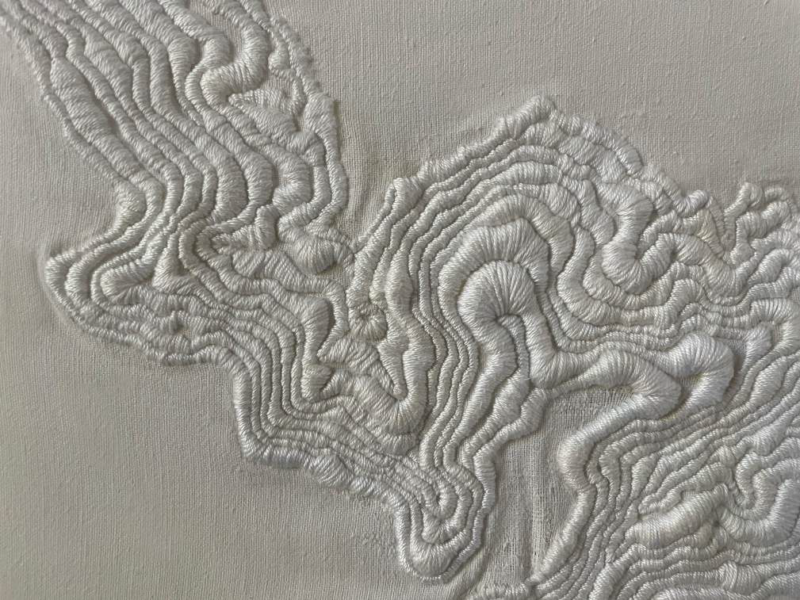
Ich habe bereits mit der Arbeit an einer Reihe von Stickereien begonnen, in denen ich topografische Karten darstelle. Diese Karten zeigen hauptsächlich Gebiete in der Ostukraine, die zu Zonen militärischer Konflikte und dauerhafter Zerstörung wurden – zum Beispiel Naturlandschaften und Städte im Donbass. Mit der für die Ostukraine traditionellen Technik „Weiß auf Weiß“ illustriere ich ihr allmähliches Verschwinden – die Verwandlung in Geisterlandschaften und Geisterstädte. Die Serie besteht derzeit aus vielen eher kleineren Stücken, aber ich habe den Ehrgeiz, auch großformatige Werke zu schaffen. Gleichzeitig spreche ich durch die Stickereien auch Umweltprobleme an – nicht nur in der Ukraine, sondern auch in anderen Teilen der Welt und allgemein.
Die Unterstützung des Atelierhaus Salzamt Linz bei der Entwicklung und Produktion der Werke dieser Kunstserie ist für mich sehr wichtig und hilfreich, da die Arbeit mit Textilien – und insbesondere die anspruchsvolle Arbeit, die ich geplant habe – viel Zeit, körperliche und materielle Ressourcen in Anspruch nehmen wird. Ich freue mich, dass ich diese Idee umsetzen und dieses Projekt verwirklichen kann, da es einen großen Schritt vorwärts in meiner künstlerischen Praxis bedeutet.
Gleichzeitig wird auch der Aufenthalt in Cité auch für meine Arbeit sehr bereichernd, da Paris als Zentrum der Modeindustrie – und damit der Textilindustrie, sowohl historisch als auch zeitgenössisch – bekannt ist. Um meine Arbeit mit neuen Techniken und Ansätzen der Textilkunst zu bereichern, bin ich beispielsweise sehr daran interessiert, das Musée des Arts Décoratifs und seine Archive zu erkunden. In Zukunft beabsichtige ich, die entstandene Textilserie an verschiedenen Orten in Österreich zu zeigen, um ein breiteres Publikum auf die Fragilität von Landschaften und natürlichen Umgebungen im Allgemeinen aufmerksam zu machen und ihm bewusst zu machen, wie schnell etwas scheinbar Dauerhaftes verschwinden und für immer verloren gehen kann, wie schnell sich alles, was wir kennen, in Geister verwandeln kann.”
Website Cité internationale des arts
Website Österreichisches Kulturforum Paris
Website Institut Français d‘Autriche
***
For the period of two months in the spring of 2025 (February to May), Olia Fedorova was awarded a residency at the Cité internationale des arts in Paris through a collaboration with the Austrian Cultural Forum Paris and the Institut Français d’Autriche.
The multidisciplinary artist was born in Kharkiv, Ukraine, in 1994 and works across conceptual art, text and textiles, photography, and video. Since the end of 2022, she has been living and working between Graz and Linz in Austria. In 2024, she began her Master’s studies in the “Textile. Art. Design” programme at the University of Arts Linz. Her artistic career has developed from a solid education: after attending the Kharkiv Art School (2008–2012), she studied interior design at the State Academy of Design and Arts in Kharkiv, where she earned her Bachelor’s degree in 2016.
Fedorova’s works have already been showcased on various international platforms. In 2025, she participated in the Kyiv Biennale at the Lentos Art Museum. Her practice has also been shaped by numerous residency programmes (selected in recent years): in 2025, she was a participant in the L’Internationale Museum of the Commons Summer School at the Irish Museum of Modern Art in Dublin and a Resident Artist at the Nirox/The Kromdraai Impact Hub as part of the Exter Programme of the Ukrainian Institute in South Africa. Other significant residencies led her to the Salzburg Summer Academy (2024), the House of Art in Ústí nad Labem (2023), Kunstnarhuset Messen in Ålvik (2023), the Norwegian Bio Art Arena in Ås (2023), and Co-iki Arts Living Space in Tokyo (2022).
Olia Fedorova speaks about her practice and the project idea she wishes to further develop in Paris:
“My artistic focus lies in exploring language (its formal and communicative properties) and the landscape as a space of meaning (trans)formation. After moving to Austria due to the war in my homeland Ukraine, I began to view landscapes from the perspective of loss and longing. By engaging with the landscapes of city and country that offered me refuge, I look back at the landscapes of my hometown and country, which seem forever lost to me—whether because they were physically destroyed by the war or because time and distance separate us. I have developed for myself the concept of ‘ghostly landscapes’ or ‘landscape memories,’ with which I work using various media and approaches. Some of these I have shown in four exhibitions (three solo and one group exhibition) that I have had in various galleries in Graz. For me, this work has become a practice of mourning and, in a way, healing—by confronting the ghosts of the past instead of running away from them. Through this, I also explore how landscapes change both physically and in content due to wars, natural and man-made disasters, and the excessive consumption of resources in a broader sense. What interests me is how landscapes become ‘ghostly’ and what happens when memories of landscapes are all that remain of them. Recently, I have been more intensively engaged with ghosts and the ghostliness of landscapes through textiles. Textile materials and techniques (such as embroidery and tapestry, which I already work with) resonate strongly with this theme. The lightness and subtlety of fabrics have always been associated with ghosts, and the calm, slow, and meditative nature of manual textile processing belongs more to the realm of the ghostly, where time and space function differently—a complete opposite to our fast-paced modern life. Therefore, I want to further develop this idea in my project and explore more deeply how various textile techniques and materials can help me implement and express it. I have already started working on a series of embroideries in which I depict topographical maps. These maps mainly show areas in eastern Ukraine that have become zones of military conflict and permanent destruction—for example, natural landscapes and cities in the Donbass. Using the traditional technique ‘white on white’ for eastern Ukraine, I illustrate their gradual disappearance—the transformation into ghost landscapes and ghost towns. The series currently consists of many rather smaller pieces, but I have the ambition to create large-format works as well. At the same time, through the embroideries, I also address environmental issues—not only in Ukraine but also in other parts of the world and in general.
The support of the Atelierhaus Salzamt Linz in the development and production of the works of this art series is very important and helpful to me, as working with textiles—and especially the demanding work I have planned—will require a lot of time, physical and material resources. I am pleased that I can implement this idea and realise this project, as it represents a significant step forward in my artistic practice. At the same time, the stay at Cité will also be very enriching for my work, as Paris is known as a centre of the fashion industry—and thus the textile industry, both historically and contemporarily. To enrich my work with new techniques and approaches to textile art, I am, for example, very interested in exploring the Musée des Arts Décoratifs and its archives. In the future, I intend to showcase the resulting textile series in various locations in Austria to draw a wider audience’s attention to the fragility of landscapes and natural environments in general and to make them aware of how quickly something seemingly permanent can disappear and be lost forever, how quickly everything we know can turn into ghosts.”
Website Cité internationale des arts